Abstract
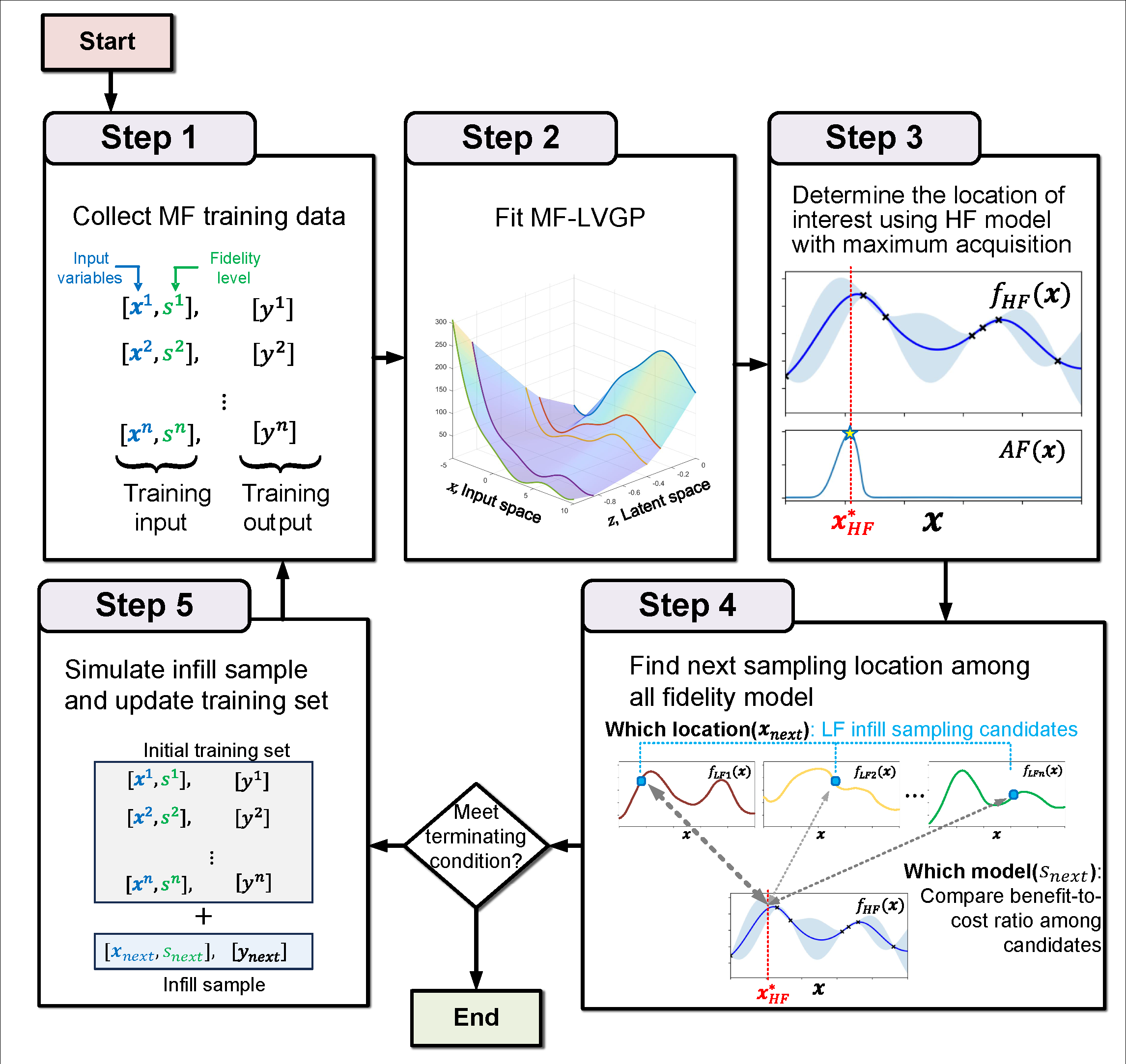
We propose a multi-fidelity (MF) adaptive sampling framework hinged on a latent embedding for different fidelity models and an associated pre-posterior analysis that explicitly uses their correlations to quantify the benefit of candidate samples as the sampling criterion. Each infill iteration includes two steps: first, we identify the high-fidelity (HF) location with the greatest potential improvement; then we search across all fidelity levels for the next sample that maximizes improvement per unit cost at that location.
This is enabled by a single Latent Variable Gaussian Process (LVGP) that maps different fidelity models into an interpretable latent space, capturing their correlations without assuming any hierarchy between fidelity levels. The LVGP lets us assess how low-fidelity sampling candidates affect the HF response via a pre-posterior analysis and select the next sample with the best benefit-to-cost ratio. The method also flexibly switches between global fitting and Bayesian Optimization by changing the acquisition function. Across test cases, it outperforms state-of-the-art methods in both MF global fitting and BO in convergence rate and robustness.
Keywords: Multi-Fidelity, Gaussian Process, Latent Variable, Adaptive Sampling, Active Learning, Pre-Posterior Analysis, Global Modeling, Bayesian Optimization