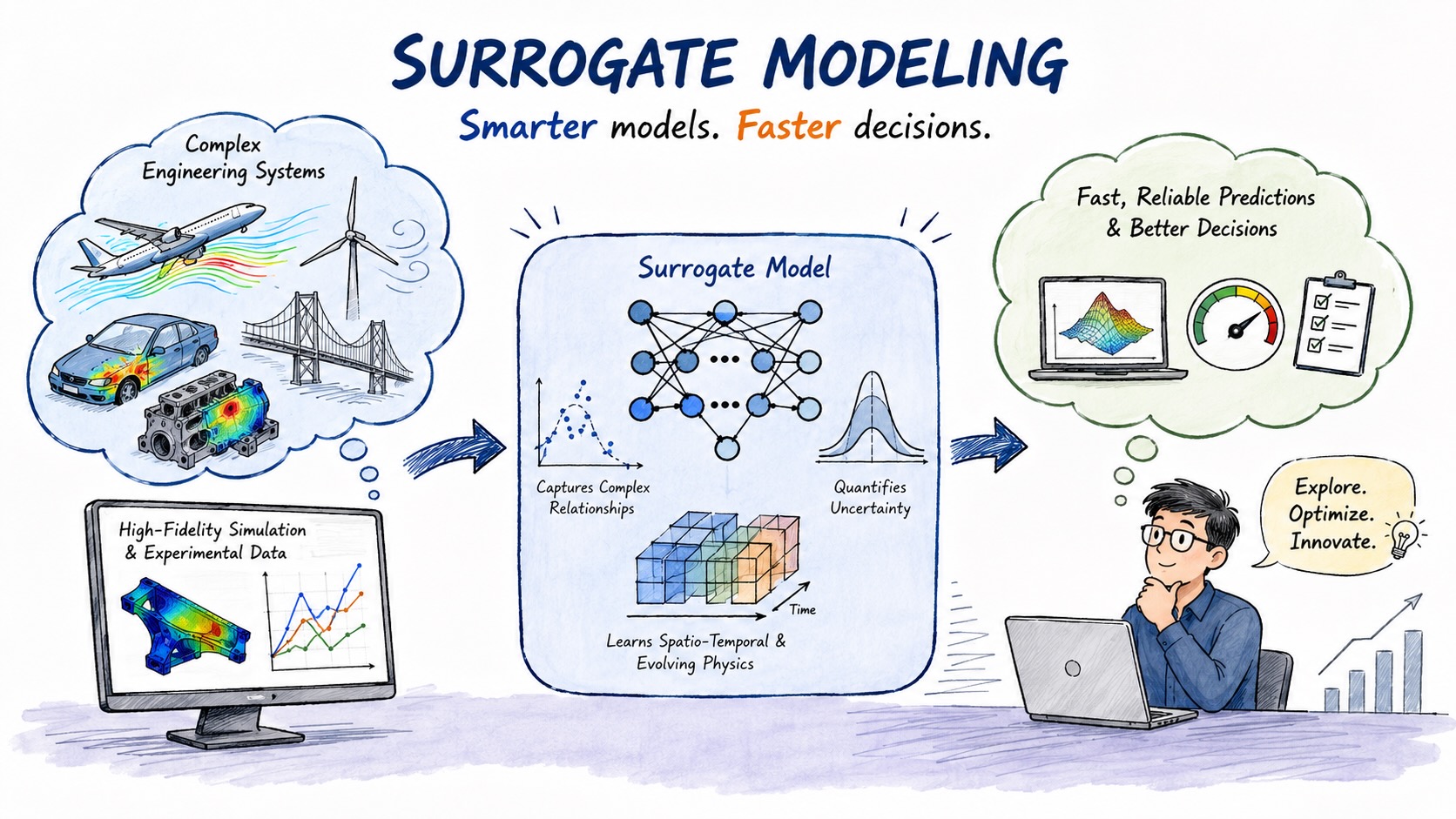
High-fidelity simulations are essential for understanding complex engineering systems, but their computational cost often limits their use in large-scale design exploration, optimization, uncertainty analysis, and real-time decision-making. Data-driven surrogate models offer a promising alternative by learning efficient approximations of expensive simulations and physical processes. However, for these models to be trusted in engineering applications, they must go beyond prediction accuracy alone.
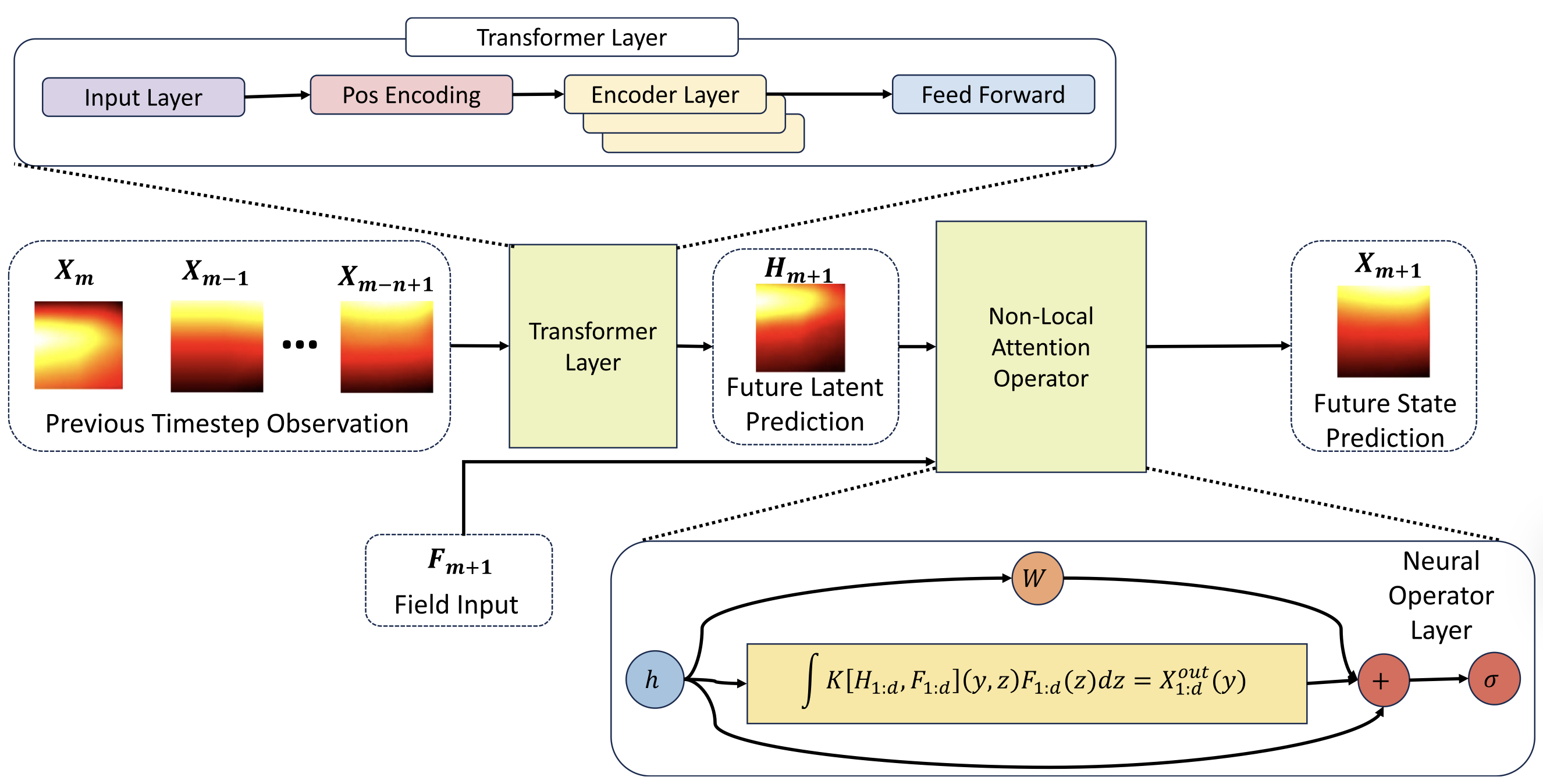
This research thrust focuses on developing reliable, interpretable, and physically meaningful surrogate modeling methods for complex and evolving engineering systems. We investigate approaches including Gaussian processes, operator learning, graph-based learning, and hybrid physics-informed models to emulate spatio-temporal dynamics, capture relationships among multiple physical quantities, and support fast prediction under changing operating conditions.
A central goal is to equip surrogate models with rigorous uncertainty quantification, improved explainability, and stronger physical interpretability. These capabilities enable engineers to understand when a model can be trusted, identify influential variables and causal relationships, and make informed decisions under uncertainty. We also develop methods for reducing simulation-to-real gaps so that models trained on computational data can better support deployment in physical engineering systems.
Through this thrust, our lab aims to create surrogate modeling frameworks that accelerate engineering analysis, enable real-time decision support, and provide trustworthy computational tools for next-generation digital engineering systems.
Selected journal articles