Abstract
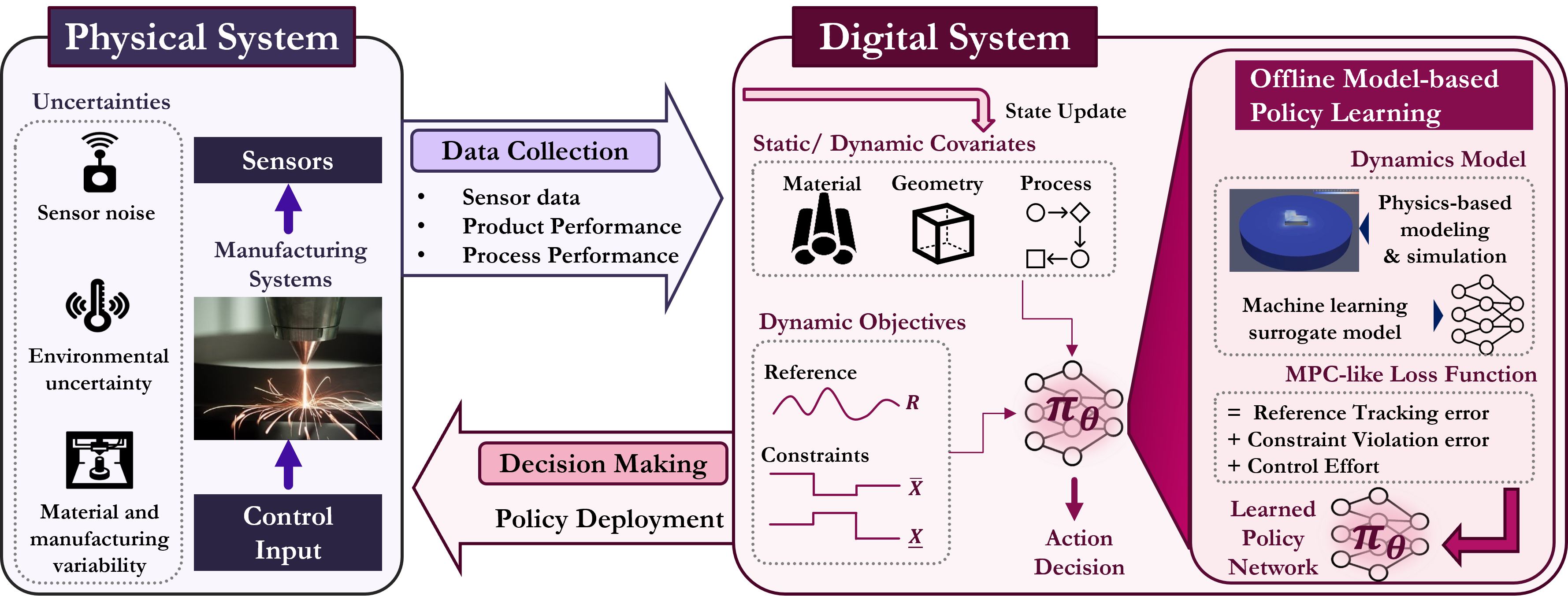
Advanced manufacturing processes such as directed energy deposition (DED) additive manufacturing (AM) involve strongly coupled dynamics, process variability, and high-frequency decision-making, making real-time implementation of model predictive control (MPC) computationally challenging. This study develops a model-based offline policy learning framework based on Differentiable Predictive Control (DPC) to enable real-time high-frequency control of manufacturing processes. The proposed framework integrates a one-shot multi-step predictor based on the Time-series Dense Encoder (TiDE) and a parameterized control policy within a fully differentiable structure, allowing the entire framework to be optimized end-to-end with respect to an MPC-inspired loss without requiring online optimization or supervised MPC data. In addition, we introduce a model rollout-based data augmentation strategy to address the limitations of open-loop control data, which often fails to capture constraint-aware behavior. Through iterative model rollouts during policy training, the proposed strategy progressively augments the training data with new trajectories, exposing the policy to constraint-aware behavior. The proposed framework is evaluated on a digital twin of DED, where the learned control policy tracks a reference melt pool temperature trajectory while satisfying melt pool depth constraints and maintaining smooth laser power regulation. Results demonstrate that the learned policy achieves tracking performance comparable to MPC while significantly reducing computational cost, with an inference time on the order of 1e-4 seconds per control step. Furthermore, the proposed method improves constraint satisfaction compared to MPC while avoiding the excessive conservativeness of robust MPC. These results highlight the potential of DPC as a practical alternative for real-time control in advanced manufacturing systems that require high-frequency decision-making.