Abstract
Digital twins — virtual replicas of physical systems that enable real-time monitoring, model updates, predictions, and decision-making — present novel avenues for proactive control strategies for autonomous systems. However, achieving real-time decision-making in digital twins under uncertainty requires an efficient uncertainty quantification (UQ) approach and optimization driven by accurate predictions, which remains a challenge for learning-based methods.
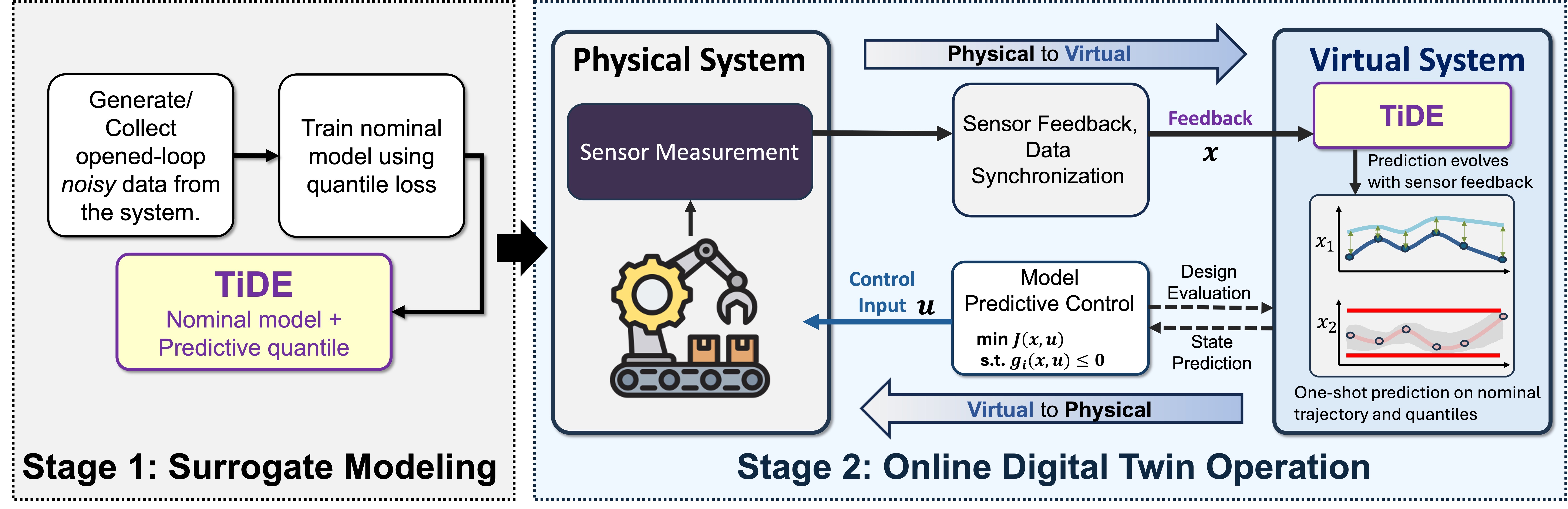
This article presents a simultaneous multistep robust model predictive control (MPC) framework that incorporates real-time, uncertainty-aware decision-making for digital twin systems. Leveraging a multistep-ahead predictor named Time-series Dense Encoder (TiDE) as the surrogate, the framework differs from conventional MPC models that provide only one-step-ahead predictions; TiDE predicts future states within the prediction horizon in one shot, significantly accelerating MPC. Quantile regression is employed during training to perform flexible and computationally efficient UQ on data uncertainty.
With the deep-learning quantiles, the robust MPC problem is formulated as a deterministic optimization problem with a safety buffer that accommodates disturbances and enhances the constraint-satisfaction rate. The proposed method outperforms existing robust MPC methods by providing less conservative UQ, demonstrated on a directed energy deposition (DED) additive manufacturing case study.
Keywords: Digital Twin, robust model predictive control, real-time decision-making, time-series, deep neural network, quantile learning