Abstract
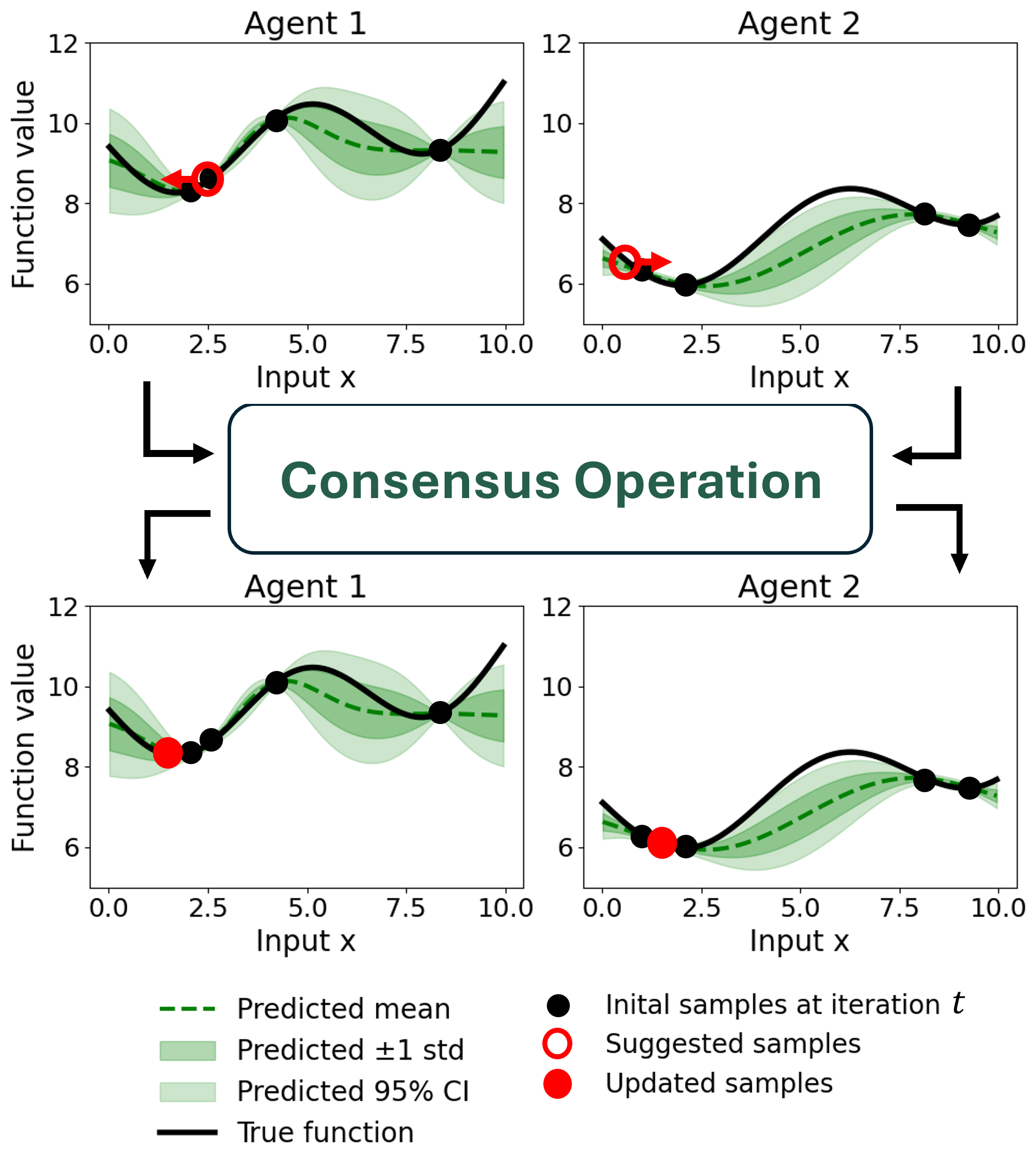
Many real-world optimization problems in scientific discovery and engineering design involve multiple design-evaluation sources — such as simulators, experiments, or manufacturing sites — that operate independently and evaluate different functions of the same underlying objective. We refer to these sources as agents. Such agents often differ in their objective-function mappings, evaluation budgets, and accessible optimization variables, which complicates coordination and information sharing.
Bayesian Optimization (BO) is a widely used framework for expensive black-box optimization, yet its standard single-agent formulation assumes centralized control and full data sharing. Recent collaborative BO methods relax these assumptions but still rely on uniform resources, fully shared input spaces, and closely aligned tasks — requirements seldom met in practice.
To address these limitations, we introduce Adaptive Resource-Aware Collaborative Bayesian Optimization (ARCO-BO), which explicitly accounts for heterogeneity in multi-agent optimization. ARCO-BO integrates a similarity- and optimal-location-aware consensus mechanism for adaptive information sharing, a budget-aware asynchronous sampling strategy for resource coordination, and a partial input-space sharing scheme for heterogeneous optimization variables. Experiments on synthetic benchmarks and high-dimensional engineering problems show that ARCO-BO consistently outperforms independent BO and existing consensus-based collaborative BO.