Abstract
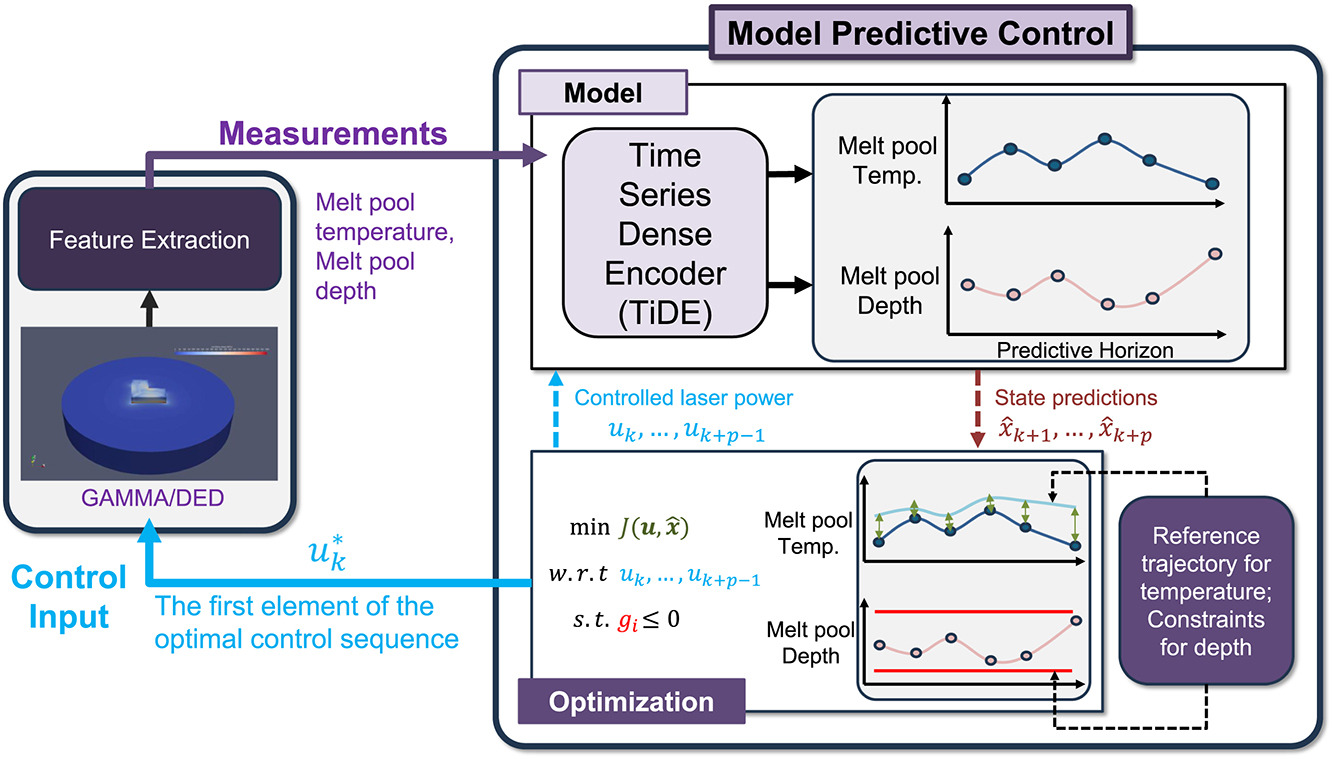
Digital Twin — a virtual replica of a physical system enabling real-time monitoring, model updating, prediction, and decision-making — combined with recent advances in machine learning (ML), offers new opportunities for proactive control strategies in autonomous manufacturing. However, achieving real-time decision-making with Digital Twins requires efficient optimization driven by accurate predictions of highly nonlinear manufacturing systems.
This paper presents a simultaneous multi-step Model Predictive Control (MPC) framework for real-time decision-making, using a multivariate deep neural network named Time-series Dense Encoder (TiDE) as the surrogate. Unlike conventional MPC models that provide only one-step-ahead predictions, TiDE predicts future states within the prediction horizon in one shot, significantly accelerating MPC. Using Directed Energy Deposition (DED) additive manufacturing as a case study, we demonstrate melt-pool temperature tracking to ensure part quality while reducing porosity defects by regulating laser power to maintain melt-pool depth constraints within a target dilution range (10%–30%).
Compared to a PID controller, MPC produces smoother, less-fluctuating laser-power profiles with competitive or superior temperature-control performance, positioning it as a powerful tool for future Digital Twin applications and real-time process optimization.
Keywords: Digital Twin, Additive manufacturing, Model Predictive Control, Time-series deep neural network, Directed energy deposition