
2026 Roadmap on Artificial Intelligence and Machine Learning for Smart Manufacturing
Published in Machine Learning: Engineering, 2026
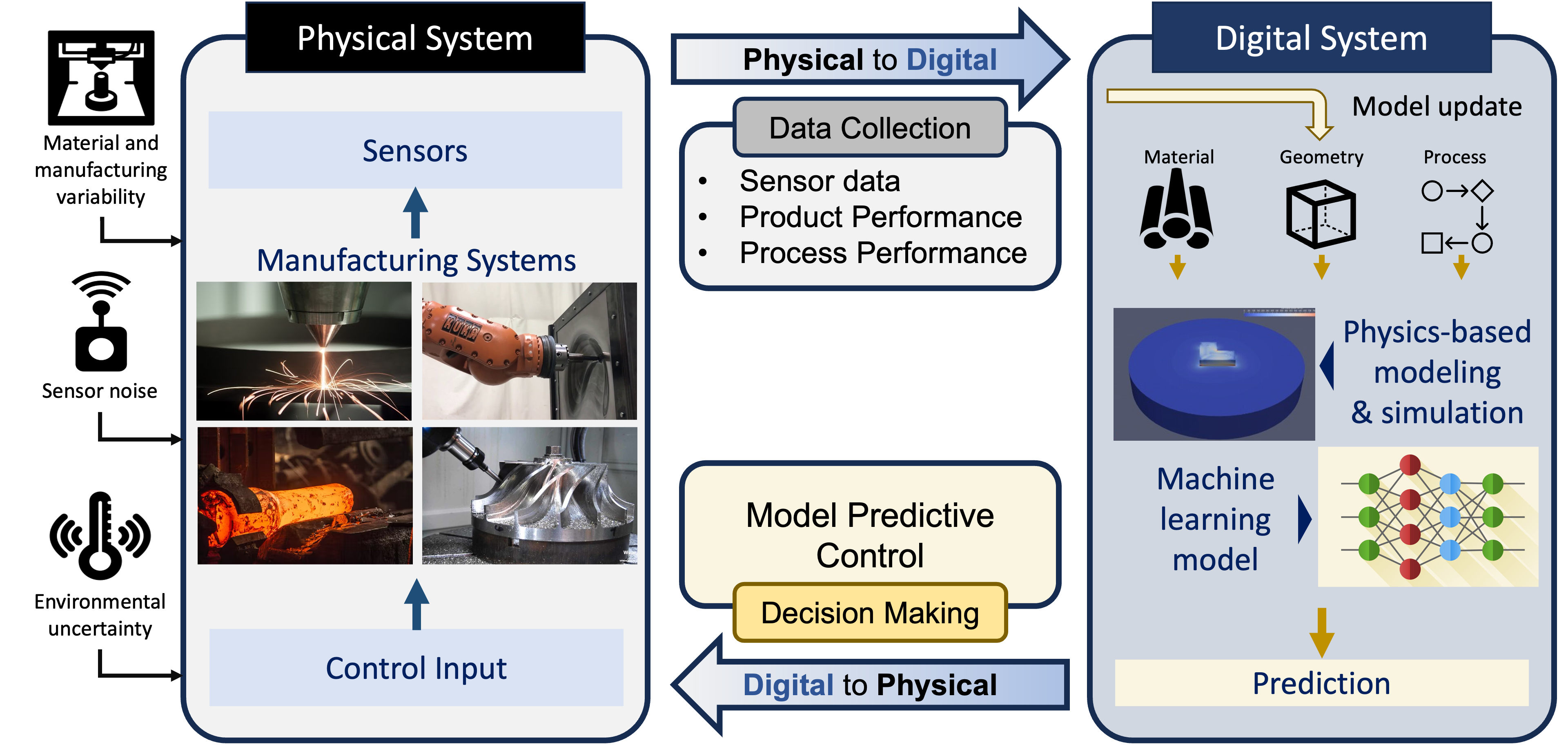
The evolution of artificial intelligence (AI) and machine learning (ML) is reshaping smart manufacturing by providing new capabilities for efficiency, adaptability, and autonomy across industrial value chains. However, the deployment of AI and ML in industrial settings still faces critical challenges, including the complexity of industrial big data, effective data management, integration with heterogeneous sensing and control systems, and the demand for trustworthy, explainable, and reliable operation in high-stakes industrial environments. In this roadmap, we present a comprehensive perspective on the foundations, applications, and emerging directions of AI and ML in smart manufacturing. It is structured in three parts. The first highlights the foundations and trends that frame the evolution of AI in smart manufacturing. The second focuses on key topics where AI is already enabling advances, including industrial big data analytics, advanced sensing and perception, autonomous systems, additive and laser-based manufacturing, digital twins, robotics, supply chain and logistics optimization, and sustainable manufacturing. The third section explores non-traditional machine learning approaches that are opening new frontiers, such as physics-informed AI, generative AI, semantic AI, advanced digital twins, explainable AI, RAMS, data-centric metrology, large language models, and foundation models for highly connected and complex manufacturing systems. By identifying both opportunities and remaining barriers across these areas, this roadmap outlines the advances needed in methods, integration strategies, and industrial adoption. We hope this roadmap will serve as a guide for researchers, engineers, and practitioners to accelerate innovation, align academic and industrial priorities, and ensure that AI-driven smart manufacturing delivers reliable, sustainable, and scalable impact for the future of manufacturing ecosystems.
Recommended citation: Jay Lee, Hanqi Su, Marco Macchi, Adalberto Polenghi, Wei Wu, Zhiheng Zhao, George Q Huang, Kiva Allgood, Devendra Jain, Benedikt Gieger, Vibhor Pandhare, Soumyabrata Bhattacharjee, Ram Mohril, Lingbao Kong, Sungjong Kim, Chan Hee Park, Byeng D Youn, Guo D Goh, Xi Huang, Wai Yee Yeong, Yung C Shin, He Zhang, Zitong Wang, Fei Tao, Jagjit Singh Srai, Satyandra Gupta, Byung Gun Joung, Albin John, John W Sutherland, Sang W Lee, Olga Fink, Vinay Sharma, Faez Ahmed, Wei (Wayne) Chen, Mark Fuge, Arild Waaler, Martin G Skjæveland, Dimitris Kiritsis, Wei Chen, Vispi Nevile Karkaria, Yi-Ping Chen, Ying-Kuan Tsai, Joseph Cohen, Xun Huan, Jing (Janet) Lin, Liangwei Zhang, Gregory W Vogl, Aaron W Cornelius, Xiaodong Jia, Dai-Yan Ji, Takanobu Minami and Ruoxin Wang, "2026 Roadmap on Artificial Intelligence and Machine Learning for Smart Manufacturing. " Machine Learning Engineering DOI: 10.1088/3049-4761/ae5967
Download Paper